Salvador hosts International Nautical Forum with debates on industry, tourism, infrastructure and the Sea Economy
Two days to discuss the sea as a driver of development
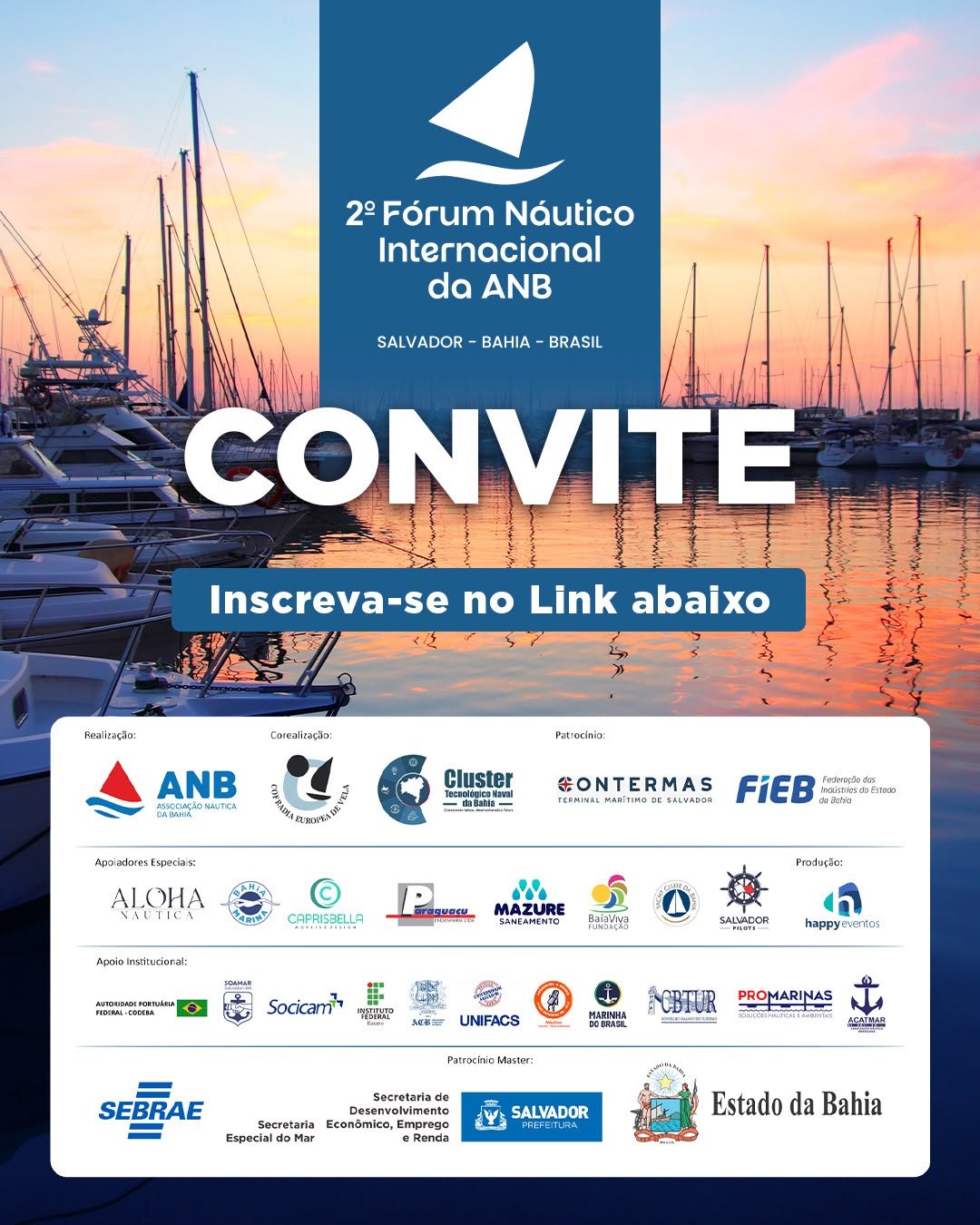
Salvador is back on the map of major debates on the development of sea-related activities. On September 16 and 17, 2026, the Salvador Maritime Terminal, in the Comércio district, hosts the 2nd International Nautical Forum of the Bahia Nautical Association (ANB).
More than discussing boats, the meeting looks at the full breadth of the Sea Economy and the Blue Economy, connecting infrastructure, tourism, industry, ports, fishing, sustainability, sports, urban planning, jobs and geopolitics.
The program released by the organizers includes 10 panels, 38 speakers and 10 moderators, gathering professionals and experts from Brazil and abroad. The event is organized by ANB, co-organized with Spain's Confraria Europeia de Vela (CEV) and the Bahia Naval Technology Cluster. ACATMAR, the Brazilian Nautical Association, is among the Forum's institutional supporters and takes part in the debates with two of its officers: president Leandro "Mané" Ferrari, as a speaker, and the Director of Tourism, Events and Sustainability, Michele Castilho Henrique Ferrari, as a moderator.
The Forum reaches its second edition with a clear goal: to strengthen the links between the productive sector, government, investors, researchers and professionals working across the different economic chains tied to the water.
Port and city open a discussion that goes beyond the pier
One of the strengths of the program is the diversity of the topics chosen.
The first panel, on the morning of September 16, addresses Port-City Integration, a strategic issue for coastal cities that need to reconcile port activity, urban development, tourism, logistics and quality of life.
The panel is expected to include Alberto Fuentes Losada, secretary general of the Port of Vigo, Spain; Antonio Gobbo, CEO of CODEBA; and Maria Eduarda Gordilho Lomanto, Salvador's Secretary of the Sea.
It will be moderated by Michele Castilho Henrique Ferrari, ACATMAR's Director of Tourism, Events and Sustainability and host of the Mundo Mar TV Show.
Having a Spanish experience in the debate broadens an important discussion for Brazil: ports do not have to be structures isolated from urban daily life. In maritime cities around the world, their relationship with the territory has become part of strategies for economic development, urban renewal, mobility and tourism.
Sports, tourism and nautical infrastructure are also on the agenda
Still on the first day, the Forum moves through different segments.
The second panel discusses Nautical Sports: Education, Health, Citizenship and Inclusion, taking sport beyond competition and looking at its potential as an educational and social tool.
Next, Nautical and Religious Tourism as Drivers of Regional Development puts two of Bahia's great vocations in the same conversation: its cultural and religious heritage and the state's historical relationship with the sea.
For a state with a long coastline, islands, bays, rivers, established tourist destinations and a strong maritime identity, discussing nautical tourism as an economic activity means far more than boat traffic. It means lodging, food, services, maintenance, retail, professional training, transport and tourist experiences.
Infrastructure closes the first day with the panel Investments in Nautical Infrastructure, Marinas and Related Facilities.
The topic touches one of the decisive points for the growth of Brazil's nautical sector: building and selling boats is not enough. The activity also depends on proper places for storage, operation, maintenance, fueling, water access and services, plus environmental planning and legal certainty.
From fishing to coastal management: the Blue Economy at different scales
The second day, September 17, opens with Fishing and Aquaculture: from Production to Gastronomy.
The idea is to bring production, sustainability, logistics and gastronomy closer together, showing how a traditional activity can join higher value-added chains when connected to innovation and territorial development.
Right after, the panel Coastal Management: Sustainable Lakes, Rivers and Oceans widens the view to environmental conservation, water management and economic development.
Expected names include João Nicolodi, professor at the Institute of Oceanography of the Federal University of Rio Grande and coordinator of Coastal and Marine Management at the Ministry of Environment and Climate Change; Camilo Mateo Botero, a coastal management researcher; and Maurício Carvalho, biologist, diver and shipwreck researcher.
It is a particularly relevant discussion because there is no consistent Blue Economy without environmental management. The challenge for governments and the private sector is to turn natural resources and geographic location into economic development without compromising the very natural heritage that sustains these activities.
Women take a strategic place in boating
The program also makes room for the panel "Boating by Women: Events, Shipyards, Marinas and Strategic Planning".
It gathers businesswomen and executives who directly manage businesses and projects in the sector, with experience in marinas, boat sales, events, sport and market development.
The topic follows a transformation already visible in the industry: more and more women are taking technical, executive, commercial and institutional roles in a chain historically associated mostly with men.
And the debate moves beyond women's presence into a new stage: leadership, decision-making and participation in the sector's growth strategy.
Nautical and naval industry puts jobs and income at the center
One of the panels most directly linked to economic development takes place on the afternoon of the 17th: Nautical and Naval Industry: Job and Income Generation.
Participants include names from industry, technology, the public sector and the Sea Economy, among them Miguel Andrade Filho, from SENAI CIMATEC; Mario Moura, from Estaleiro Enseada; Mila Paes, Salvador's Secretary of Economic Development, Employment and Income; and Leandro "Mané" Ferrari, president of ACATMAR and of Blue Nautical Hub Brasil, who brings to the panel the experience of Santa Catarina, the state behind about 70% of Brazil's recreational boat production.
Having this topic at the Forum helps shed light on a feature often overlooked by those who see boating only through the final product.
A boat is the result of a long production chain: shipyards, engines, electronics, electrical systems, composites, joinery, upholstery, glass, stainless steel, painting, design, engineering, logistics, maintenance, marinas, retail, tourism and a range of specialized services.
It is precisely this reach that makes the nautical industry a potential generator of jobs and business far beyond the shipyard.
Blue Amazon and geopolitics come into view
The Forum also brings to the stage a discussion that has gained even more weight in recent years: Oceans, Economy and World Geopolitics.
The agenda covers the strategic importance of the Blue Amazon, sovereignty over Brazilian jurisdictional waters, maritime security and the role of the oceans in the country's international positioning.
It is a topic that brings the Sea Economy closer to defense, energy, foreign trade, shipping routes, science, natural resources and international relations.
In a world where much of global trade depends on shipping, seeing the ocean only as scenery is no longer enough. It is infrastructure, territory, a source of resources, a logistics corridor and an element of sovereignty.
Cases show when the Sea Economy leaves the concept and becomes a project
The closing panel is titled "Inspiring Cases: what worked!".
The idea is to present experiences that show, in practice, how water-related projects can transform cities and territories.
Waterway mobility, port revitalization, sustainability, nautical infrastructure, innovation and public-private cooperation are among the threads presented by the organizers.
This may be one of the most important aspects of meetings like the ANB International Nautical Forum: putting side by side those who plan, regulate, research, invest and actually deliver.
Because the Sea Economy stops being just a concept when it starts generating infrastructure, companies, tourism, technology, jobs and opportunities in coastal territories.
Bahia wants a bigger place in the Sea Economy
According to ANB, the initiative's goals include expanding international exchange, connecting governments, experts and investors, and strengthening Bahia as a development hub for the nautical sector.
Holding an international Forum in Salvador also draws attention to an advantage right in front of the state: its geographic, economic and cultural relationship with the sea.
Turning that vocation into development, however, depends on planning, infrastructure, business environment, workforce training, sustainability and institutional coordination.
That is exactly where events like the Forum matter: less for the isolated discussion of one segment and more for the chance to get the different chains of the Sea Economy talking to each other.
Alongside the debates, the event also hosts the 1st Business and Nautical Tourism Expo, designed as a meeting space for companies, the market, tourism, investors and public institutions.
Details
2nd ANB International Nautical Forum
When: September 16 and 17, 2026.
Where: CONTERMAS, Salvador Maritime Terminal. Avenida da França, Comércio, Salvador, Bahia.
Free registration: use the "Register for free" button on this page.
Organized by: ANB. Co-organized by: Confraria Europeia de Vela and the Bahia Naval Technology Cluster. Institutional support: ACATMAR, Federal Port Authority (CODEBA), SOAMAR Salvador, Socicam, Instituto Federal Baiano, UNIFACS, Brazilian Navy, CBTUR and Promarinas, among others.
The organizers note that the program and panel line-ups may change.