Santa Catarina's boatbuilding industry: a supply chain that generates jobs and income
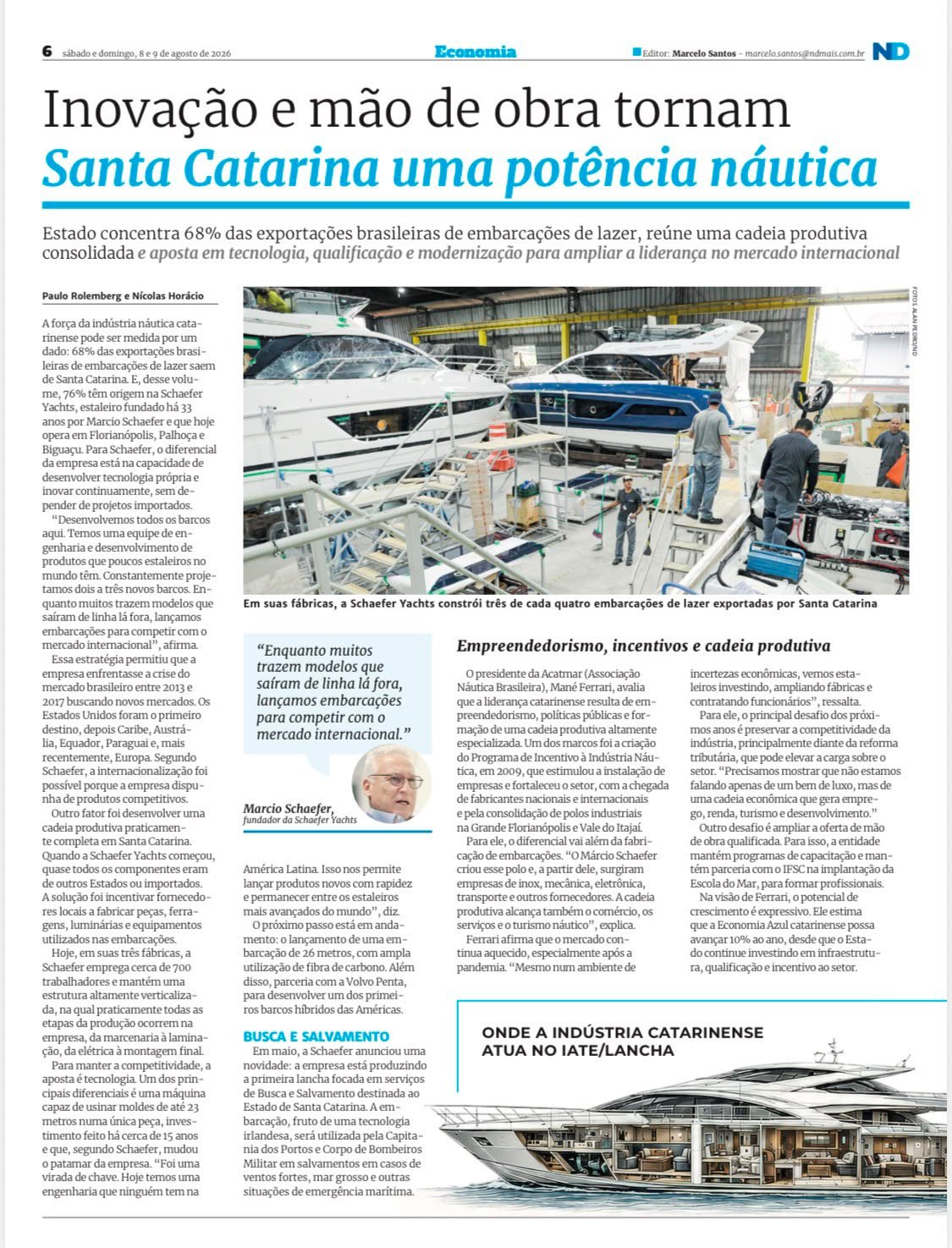
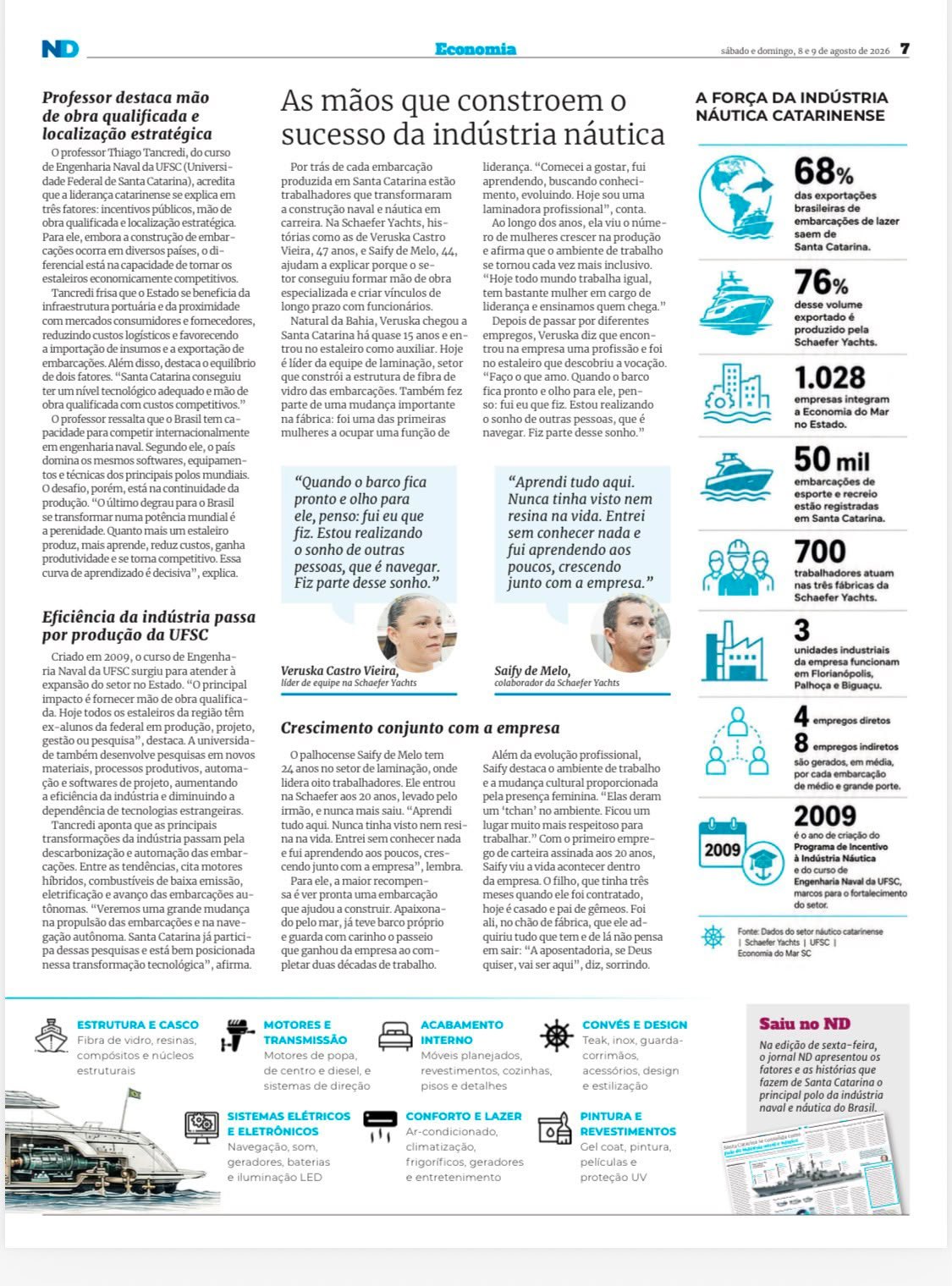
Santa Catarina has established itself as Brazil's leading nautical hub, and the numbers help to grasp the scale of this work. The state accounts for 68% of Brazil's exports of leisure boats and brings together a mature supply chain involving more than a thousand companies linked to the Blue Economy. The subject was featured in a report by Jornal ND, in the 8-9 August edition, which interviewed ACATMAR's president, Mané Ferrari.
For Ferrari, Santa Catarina's leadership is not the work of a single company. It stems from entrepreneurship, sound public policy and, above all, from a highly specialized supply chain. "We need to show that we are not talking only about a luxury good, but about an economic chain that generates jobs, income, tourism and development," he says.
The sector in numbers
According to the data gathered in the report, 1,028 companies make up the Blue Economy in Santa Catarina. The state has around 50,000 registered sport and recreational vessels and accounts for more than two thirds of all leisure boats Brazil exports. Each medium and large vessel generates, on average, 4 direct jobs and another 8 indirect ones, showing how the activity spreads across the whole economy.
Many hands in every boat
A finished boat is the sum of the work of dozens of companies and professionals. Some handle the structure and hull, with fiberglass, resins and composites. There are the suppliers of engines, transmission and steering systems. Then comes the interior finishing, with joinery, built-in furniture and coverings. Add to that the deck and design, in stainless steel and wood; the electrical and electronic systems, from navigation to lighting; comfort items such as air conditioning and generators; and, finally, painting and protection. Each of these stages is a company, a craft, a job. It is the supply chain working together.
Workforce and training
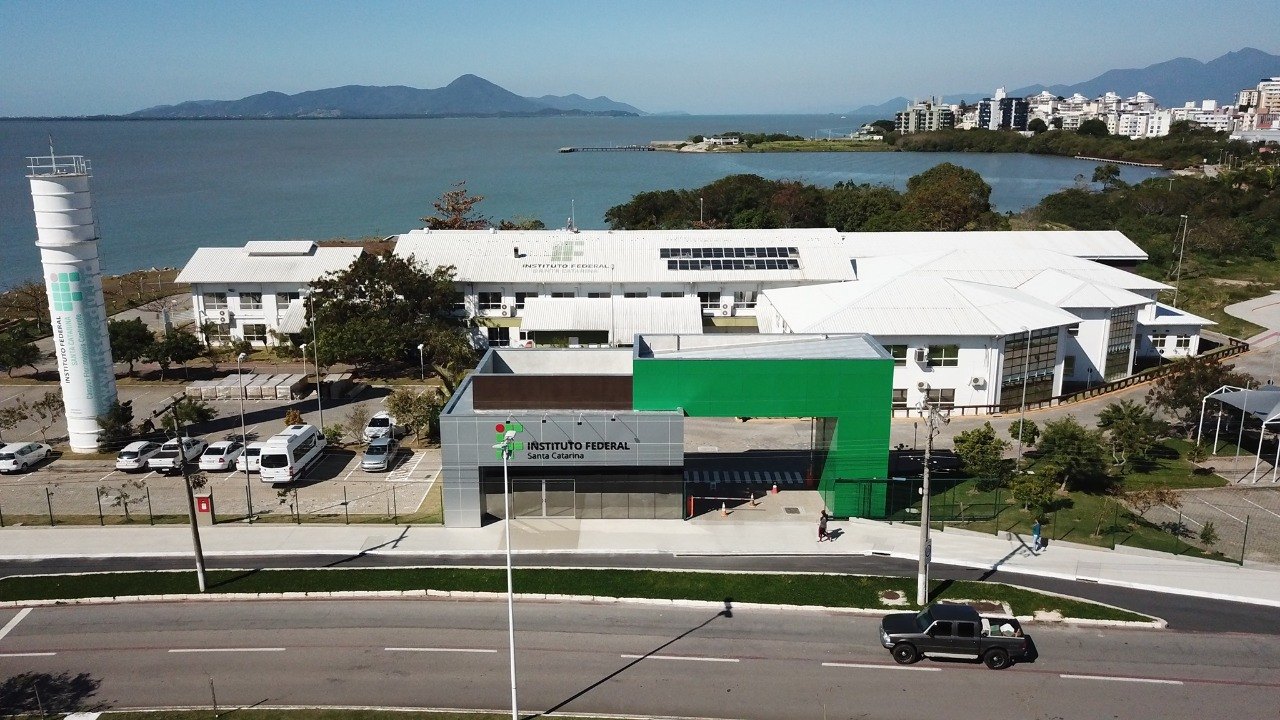
Many of these professionals learned the trade inside the factories themselves and grew in their careers. It is common to find someone who started as an assistant and now leads teams, and more and more women hold production roles. To keep up this pace, training is decisive. The Naval Engineering course at UFSC, created in 2009, trains skilled labor and develops research into new materials and automation. ACATMAR runs training programs and works, in partnership with IFSC, on setting up the Escola do Mar (School of the Sea) to train professionals for the sector.
A heated market, with challenges
Ferrari believes the market remains heated, especially after the pandemic. "Even in an environment of economic uncertainty, we see shipyards investing, expanding factories and hiring," he says. Among the challenges of the coming years, he points to the need to preserve the industry's competitiveness in the face of tax reform and to expand the supply of skilled labor. ACATMAR's president estimates that Santa Catarina's Blue Economy could grow around 10% a year, as long as the state keeps investing in infrastructure, training and incentives for the sector.
The 2009 milestone
A turning point for the sector was 2009, the year the Nautical Industry Incentive Program and the UFSC Naval Engineering course were created. The measure encouraged new companies to set up, attracted manufacturers and suppliers, and helped consolidate the industrial hubs of Greater Florianópolis and the Itajaí Valley. Since then, the sector has grown and organized itself around a chain that is now a national benchmark.
The Jornal ND report reinforces a message ACATMAR keeps repeating: the strength of Santa Catarina's nautical industry lies in the people and companies that build, every day, each vessel. It is an economy of the sea that generates jobs, income and a future for Santa Catarina.
Credits: report by Paulo Rolemberg and Nícolas Horácio, with photos by Alan Plumdno, published in Jornal ND, Economy section, weekend edition of 8-9 August 2026. The images reproduced on this page correspond to pages 6 and 7 of that edition and belong to Jornal ND.