US tariff on Brazilian vessels in 2026: what applies, what changed and how to deduct American content (HTSUS 9802.00.80)
The tariffs imposed by the United States on Brazilian products changed several times in 2026, and much of the information circulating in the nautical sector has become outdated. This ACATMAR briefing gathers, based on official sources, what actually applies today to the export of Brazilian vessels to the United States, corrects the 75-percentage-point calculation that circulated in the market, and explains the legal mechanism that allows components manufactured in the United States, such as engines, generators and onboard electronics, to be deducted from the dutiable base.
The aim is to serve as a technical reference for shipyards, suppliers, distributors, customs brokers and other professionals in the production chain. Every statement has its source cited at the end.
What applies today, in September 2026
The timeline matters, because a lot of information in circulation is outdated:
February 20, 2026: the United States Supreme Court held that IEEPA does not authorize the President to impose tariffs, invalidating the tariffs created on that basis, which includes the additional 40% and the so-called 10% reciprocal tariff.
February 24, 2026: a temporary 10% duty took effect under Section 122, valid for 150 days, therefore expiring around July 24, 2026.
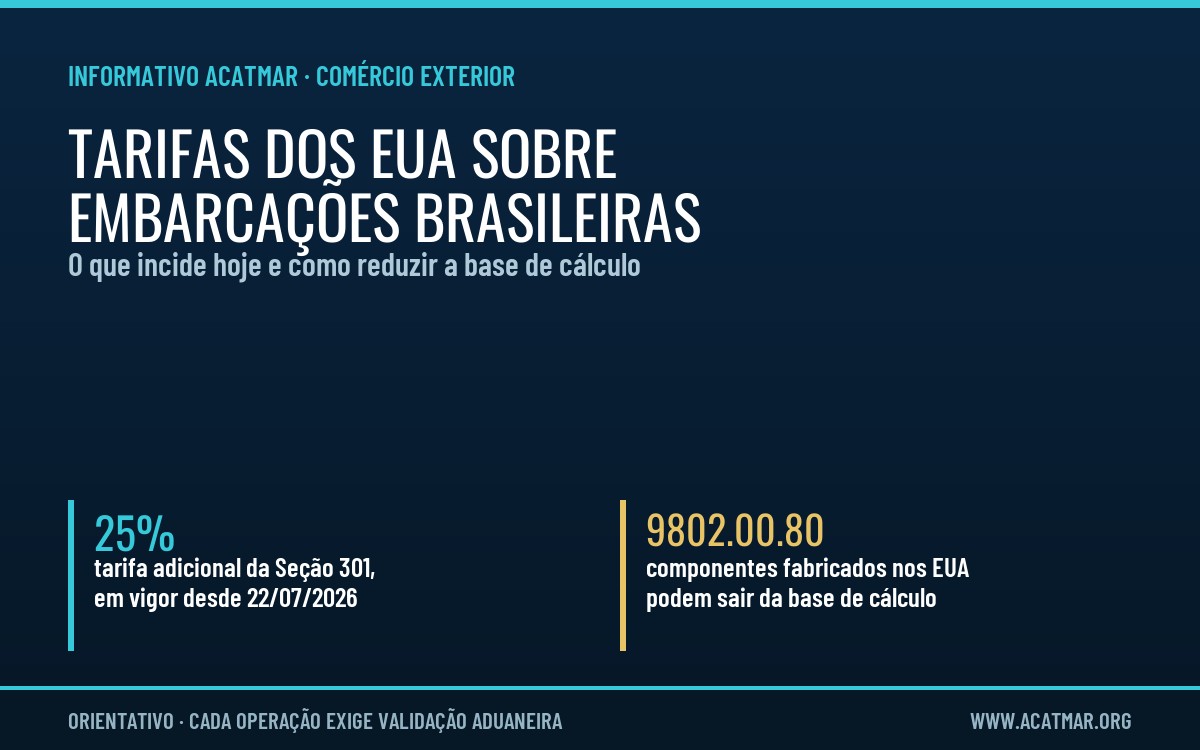
July 22, 2026: the additional 25% duty under Section 301 took effect, applicable to most goods of Brazilian origin, with a specific list of exceptions.
In practice, then, today's calculation is the ordinary (MFN) duty of the specific commodity code plus the additional 25% under Section 301. For recreational vessels the ordinary duty is historically low, but it must be confirmed case by case by the code used at import.
Correcting the 75% figure
The reading circulated in the sector that the new 25% would stack on top of the previous 40% and the 10% reciprocal, reaching 75 percentage points. That calculation does not hold today, because both the 40% and the 10% reciprocal were based on IEEPA, which was invalidated by the Supreme Court, and the Section 122 10% expired.
In other words: the estimates of around 30% circulating in the sector are much closer to today's reality than 75%. This does not diminish the seriousness of the measure, but planning prices and contracts with a figure three times higher than the real one is also a costly mistake.
Vessels are within reach of the measure
Chapter 89, which classifies vessels, does not appear among the exceptions expressly provided in the measure. The transition window for goods already shipped before entry into force closed on July 29, 2026. The exact rate, however, always depends on the specific code used at import, which reinforces the need for model-by-model analysis.
Do US-manufactured components reduce the duty? Yes, and there is a legal basis
Yes. United States customs law provides subheading 9802.00.80, covering articles assembled abroad, in whole or in part, from components manufactured in the United States.
Under that regime, duties, including additional ones such as Section 301, apply only to the foreign value added. The cost or value of the US-origin components is deducted from the value of the article.
Translated to a shipyard's reality: engines, generators and electronic equipment demonstrably manufactured in the United States and installed on the vessel may be taken out of the dutiable base. On boats where these items represent a relevant share of value, the real impact of the tariff drops significantly.
The conditions, and this is where many get it wrong
The benefit is not automatic. To apply, strict requirements must be met:
Origin, not brand. The component must actually be manufactured in the United States. Many engines and electronics from American brands are produced in Mexico, China or Japan. Verification is item by item, by origin documentation, never by assuming from the brand.
Exported ready for assembly. Components must leave the United States in a condition ready to be assembled, without further fabrication in Brazil.
Without losing physical identity. The component cannot be changed in form or substance, nor improved beyond assembly itself and incidental operations.
Documentation and proof of value. The origin and the cost or value of each American component must be proven, with proper documentary control.
The claim is made at entry, by the importer. Classification under 9802.00.80 is declared by the US importer at clearance, following the qualification and evidence rules of United States customs regulations.
How to build the calculation, step by step
1. Correctly classify each model under the code used in the United States.
2. Determine the customs value of the operation.
3. Map all US-origin content of the vessel, with origin and value documentation.
4. Calculate the base after the deduction provided in 9802.00.80.
5. Apply the ordinary duty plus the additional 25% on that base.
6. Add freight, insurance, port costs, clearance and distribution to reach the real cost of placing the boat in the market.
Illustrative example only: a US$ 1 million vessel carrying US$ 250,000 in engines, generators and electronics demonstrably manufactured in the United States would calculate the additional duty on US$ 750,000. The 25% would result in US$ 187,500 instead of US$ 250,000, a difference of US$ 62,500 in a single operation. The figures are fictitious and serve only to show the logic of the calculation.
Other instruments worth studying
Beyond 9802.00.80, other paths deserve technical analysis: customs valuation rules and what actually makes up the dutiable value; duty drawback, where re-export occurs; the use of foreign trade zones in the United States for inventory management and deferral; and, above all, contract review.
Incoterms, change-of-law clauses, force majeure, price adjustment, cancellation and responsibility for paying duties define who absorbs the increase. Contracts signed before the change are not automatically protected and must be read carefully.
What not to do
Internationalizing production is a legitimate business strategy when there is real industrial operation, investment and substantial transformation of the product. What cannot be done is routing the vessel or its components through a third country merely to mask Brazilian origin. American rules provide specific penalties for operations characterized as transshipment or triangulation aimed at tariff evasion. The risk is customs-related, financial and reputational.
ACATMAR's recommendation
No company should make pricing, contract or shipping decisions based on generic information, including this briefing. Every operation must be validated by a customs broker and by legal counsel specialized in foreign trade, because tariff classification, proof of origin and qualification under 9802.00.80 are analyzed case by case.
ACATMAR has, among its members, companies and professionals working in customs law, foreign trade and international logistics. Members who need guidance to find this support can contact the association.
Our practical recommendation is that each shipyard build an exposure matrix by model, identify the American content of each vessel and simulate at least two scenarios: with and without the deduction. Knowing that number before negotiating is what separates those who preserve margin from those who lose market.
Frequently asked questions
What is the United States tariff on Brazilian vessels in 2026? Since July 22, 2026, the additional 25% Section 301 duty applies, on top of the ordinary (MFN) duty of the vessel's specific code.
Does the 25% stack with the previous 40% and 10%? Not in the current situation. The 40% and the 10% reciprocal were based on IEEPA, invalidated by the Supreme Court on February 20, 2026, and the 10% Section 122 duty expired around July 24, 2026.
Are vessels exempt from Section 301? No. Chapter 89, which classifies vessels, does not appear among the exceptions expressly provided in the measure.
Can US-origin engines, generators and electronics be deducted? Yes, under HTSUS subheading 9802.00.80, provided they are actually manufactured in the United States, exported ready for assembly, retain their physical identity and have proven origin and value. The claim is made by the US importer at entry.
Does an American brand guarantee American origin? No. Origin is defined by the place of manufacture, and many products from American brands are made in other countries. Verification is item by item, by origin documentation.
How to calculate the tariff when exporting a boat to the US? Classify the model under the US customs code, determine the customs value, deduct the proven American content (9802.00.80) and apply the ordinary duty plus 25% on the resulting base, then add freight, insurance and distribution costs.
"Technical information is defense. The Brazilian nautical sector has plenty of industrial competence, but competence does not cancel a tariff barrier. What protects us is knowing the rule, reviewing the contract, diversifying markets and acting together, as an organized sector," says Mané Ferrari, president of ACATMAR.
Important notice: this material is informative and guidance-oriented, does not constitute legal, accounting or customs advice, and does not replace individual analysis of each operation by a qualified professional. Foreign trade rules change frequently and must be confirmed on the date of the operation.
Sources: Office of the United States Trade Representative (USTR), Federal Register, U.S. Customs and Border Protection (CBP) and Title 19 of the United States Code of Federal Regulations.